


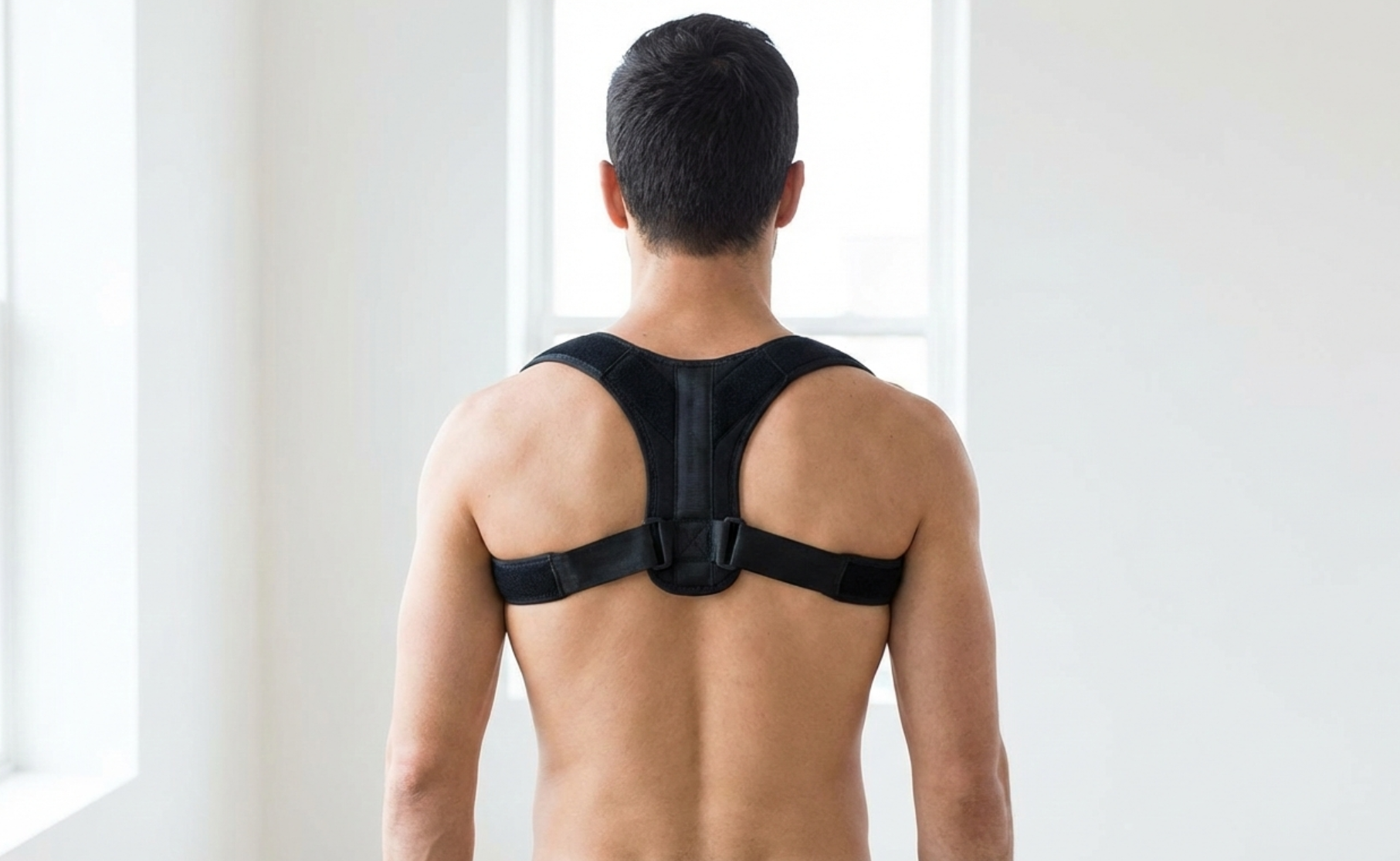
On Posture-Correcting Shoulder Braces
I see a lot of Google searches for posture-correcting braces promising to “pull your shoulders back,” “fix slouching,” and “improve posture instantly.”
Strap it on, stand taller, problem solved… right?
Not quite. Treating posture braces as a solution to slouching is a bit like wearing a bra and calling it musculoskeletal care. A wearable crutch can offer temporary relief, but it fails to address why things ended up there in the first place. I challenge you to find anyone who wears a bra that doesn’t feel a sense of relief when taking it off.
Posture Is Not a Clothing Problem: Why the Shoulder-Bra Idea Falls Apart
Imagine yourself saying, “My shoulders round forward, so I’m wearing this supportive garment to hold them back all day. Why didn’t my parents think of this?”
Rounded shoulders aren’t caused by a lack of external support. They’re the result of maladaptation:
- Vertebrae that collapse forward due to habits and gravity
- Muscles and joints that compensate by twisting and twisting as a result
- A nervous system that has learned, “This is the position we live in now.”
Support garments are crutches, not teachers. They can’t restore mechanical advantage, mobility, strength, or coordination. They can only apply compression.
A brace treats posture as if it’s a wardrobe issue, but posture isn’t about actively holding a position. It’s about the fact that your body’s default position is one of upright comfort.
It’s worth repeating: The body’s default position is one of upright comfort.
No strap can accomplish this.
External Force ≠ Internal Equilibrium
A posture brace works by applying an external force. Like your stiff muscles, it attempts to hold you backward when your body collapses forward.
That creates two problems:
- It bypasses the muscles that are working to hold you upright, thereby transferring torque and stiffness to your joints. Try to tie your shoes with your shoulders forced backward. Moreover…
- It ignores the reality that those muscles should not be working that hard in the first place. If you want to wear a cast all day, don’t be surprised if you can’t move as well as you did before.
The brace doesn’t fix your problems so much as it forces your body to compensate differently (hopefully in a way that takes pressure off of your area of complaint). Further maladaptive changes are necessary to compensate for the resulting position that you adopt (anterior pelvic tilt is a common example).
What Actually Fixes the Problem
Rounded shoulders are a symptom, not a lack of discipline or a moral failing. Improving posture means improving the mechanics underneath it:
- Re-distribution of the weight of the body from the muscles to the skeleton,
- Training strength and endurance in the muscles that loosen as a result,
- A thorough evaluation and optimization of every ergonomic situation that you adopt
- Awareness that’s built through freedom and not restraint.
This doesn’t mean standing rigidly all day. It means removing the need for that rigidity in the first place.
Posture isn’t something you strap on. Lasting change only happens when the structure does.
It takes no more than 20 minutes to prove these concepts. Click the button below to schedule an appointment.